Conservation Science · Sikh Sacred Manuscripts · Structural Book Physics
Why Your Pothi Sahib’s
Endleaves Are Tearing
The fluid mechanics and material science behind a silent, preventable form of damage to stab-stitched Pothi Sahibs — and what every sevadar can do about it.
A Sacred Object Under Invisible Mechanical Forces
The Pothi Sahib — whether a complete Saroop of Sri Guru Granth Sahib Ji or a smaller Gutka Sahib — is among the most carefully handled books in the world. Sevadars carry it with covered hands, practitioners maintain strict protocols around its placement and care. And yet, in Gurdwaras across the globe, one form of damage quietly accumulates year after year: the endleaves pleat, buckle, and tear.
The cause is not carelessness. It is physics — specifically, the interaction between a stab-stitched binding structure and the air that becomes trapped inside it during Parkash. Understanding this mechanism is the first and most important step toward preventing it.
As an art conservator who works closely with Sikh communities, I have written this piece to make that science accessible — not to replace devotional care, but to deepen it.
The Tell-Tale Pleat: Reading the Damage
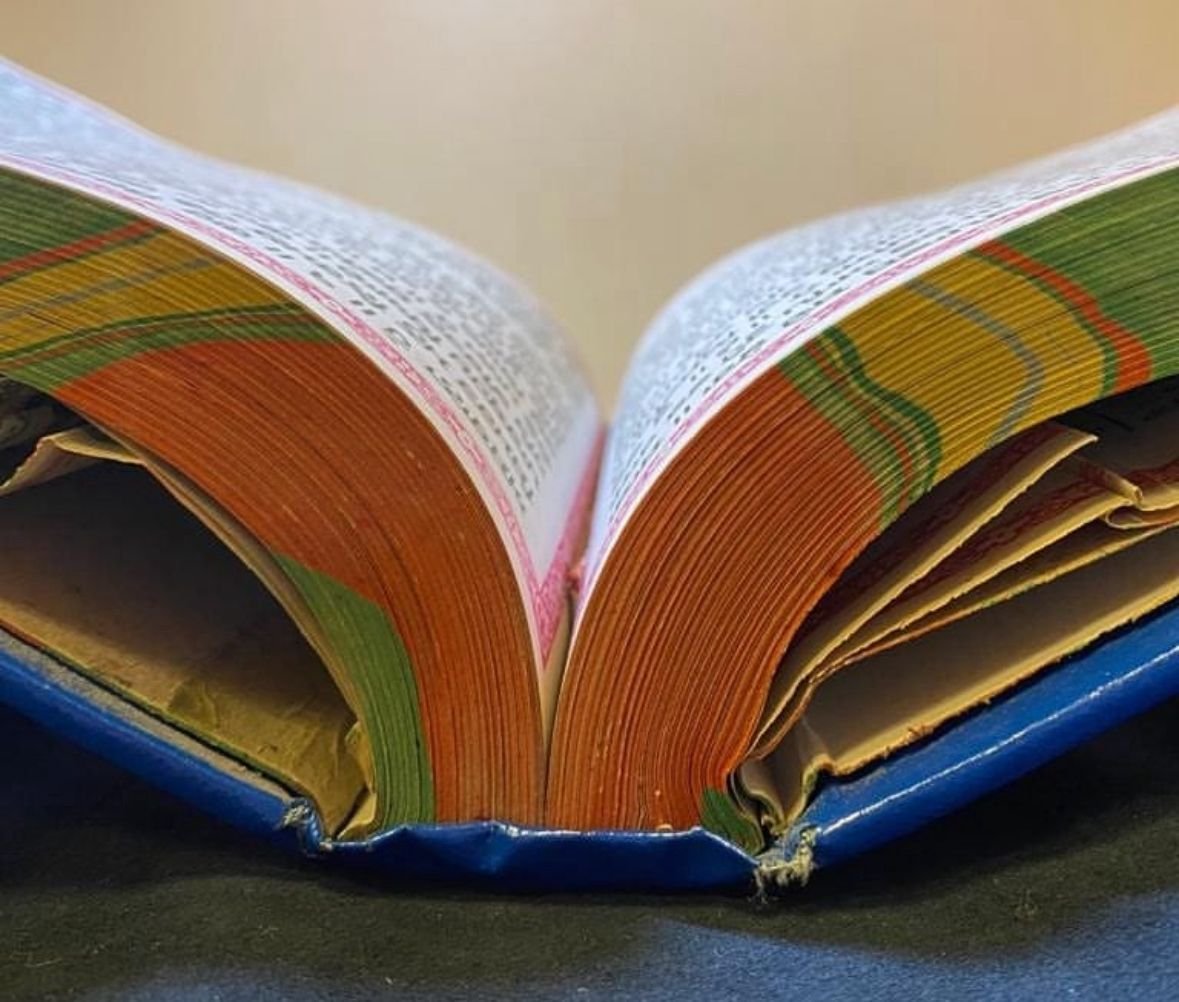
What Fig. 1 shows is extremely common in modern printed Pothi Sahibs. The endleaves — the decorative and structural pages that connect the textblock to the cover boards — have developed accordion-like pleats and longitudinal tears running parallel to the spine. The cover cloth is lifting away at the lower joint. This is a structural failure, and it has a specific, identifiable physical cause.
Modern Pothi Sahibs are bound using stab-stitching: a technique in which long needles pierce through the entire textblock from board-side to board-side, with thread running parallel and close to the spine edge. This method is practical for thick, heavy volumes — but it creates a critical structural constraint. The thread locks every page in a rigid, unified block. Unlike more flexible binding structures, the textblock cannot move flush against the cover boards when the book is opened. The result is a gap — an enclosed volume of air between the inner face of each cover board and the first page of the textblock. This gap is the source of all the damage.
“The paper remembers every force that has ever been applied to it. Our task is to ensure that what it remembers is gentleness.”
What Physics Tells Us About Every Closing
The Compression Air-Pocket: Why Closing the Book Damages It
When the Pothi Sahib is open for Parkash, an air pocket exists at atmospheric pressure (P₁) in the space between the cover board and the textblock — call this volume V₁. When the book is closed, the board presses inward, compressing this pocket. The new volume V₂ is much smaller. By Boyle’s Law:
The now-pressurised air must escape. It forces its way through the only flexible exit available: the thin paper endleaf at the gutter edge. This creates a rapid suction-and-expulsion event — experienced by the endleaf as a violent, localised pressure wave. Repeated over hundreds or thousands of Parkash cycles, this is precisely what produces the pleats and tears we see.
Why Wide Opening Angles Accelerate Failure
A second mechanism compounds the damage: bending moment. The cover board, when opened wide, acts as a long lever arm pivoting at the spine joint. The endleaf must bridge the angle between board and first page. The tensile stress (σ) at the fold point is governed by:
Where E is the elastic modulus of the paper and ε is the strain from angular displacement. A wider opening angle increases ΔL — the amount the endleaf must stretch. Each open-and-close cycle accumulates microscopic fibre fractures. This is fatigue failure — the same mechanism that causes a metal paperclip to snap when bent repeatedly. Paper fails the same way, just more slowly and less visibly, until it tears.
The Geometry of Protection: Weak vs. Strong Cushions
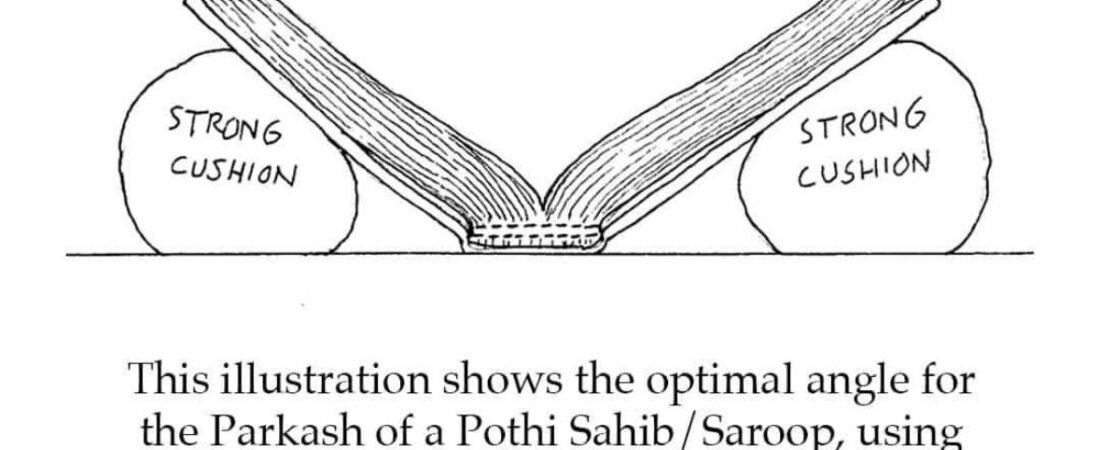
The critical variable controlling how much damage occurs is the opening angle of the Pothi Sahib during Parkash — and this is directly determined by the cushions placed beneath the cover boards.
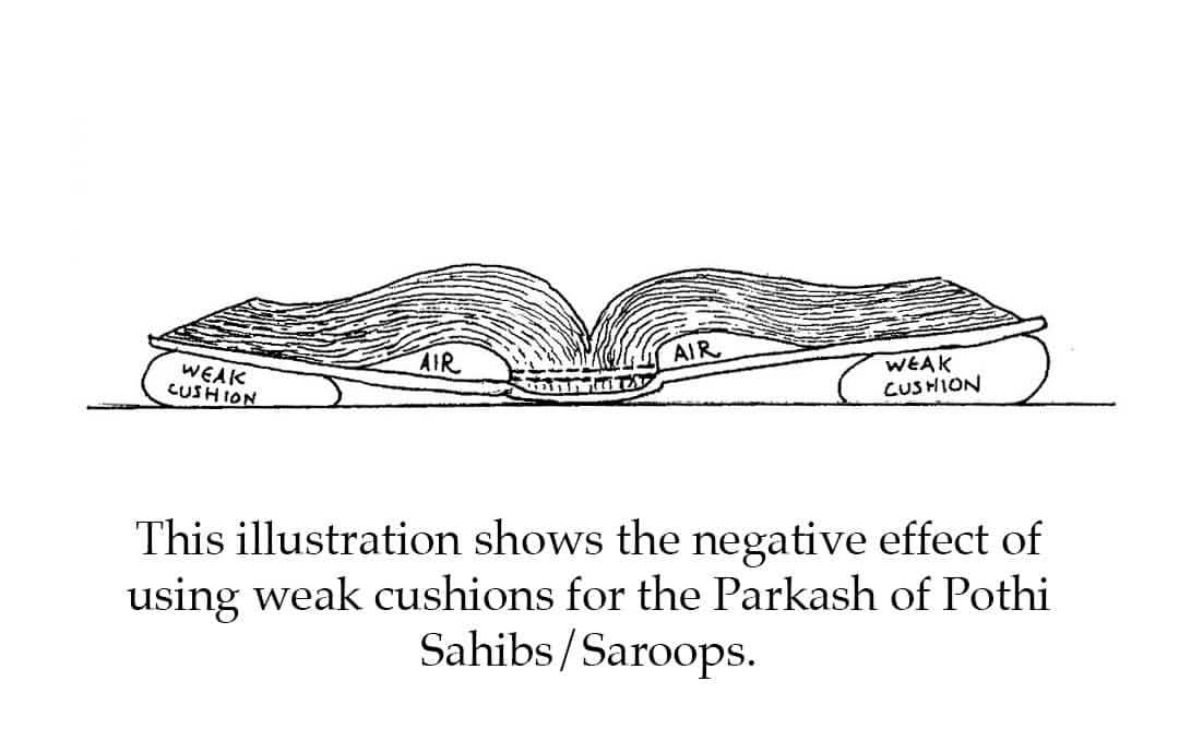
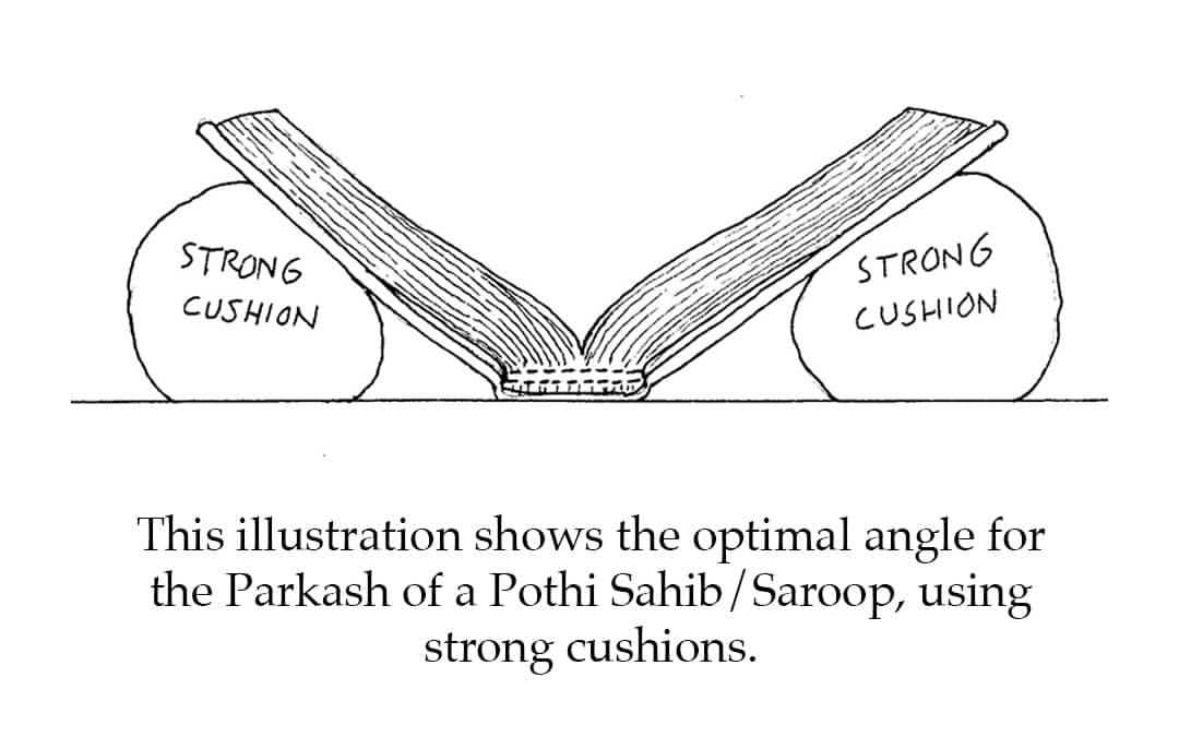
Weak cushions (left): The book opens nearly flat — approaching 180°. Large air pockets form on both sides between cover and textblock. On closing, these large volumes compress rapidly, generating a powerful pressure spike at the endleaves. This is the primary driver of suction pleating and tearing.
Strong cushions (right): Firm cushions hold the boards at a narrow angle — approximately 60–70°. The air pocket volume is dramatically reduced. On closing, only minimal pressure is generated. The endleaves experience safe, low levels of mechanical stress. No pleating. No tearing. The binding survives thousands of Parkash cycles intact.
The physics is direct: a wider opening angle means a larger initial air volume V₁, a greater compression event, and a larger pressure spike P₂ forced through the endleaf. Narrow angle = small pocket = safe closure. Every time.
Five Principles of Structurally Sound Parkash
The goal is not to change the practice of Parkash — it is to support it in a way that protects these irreplaceable objects for future generations. Each principle below is grounded directly in the physics described above.
-
1Use firm, well-structured cushions. Cushions must resist compression under the weight of the cover board. Soft or flattened cushions allow the book to open too flat, enlarging air pockets and increasing endleaf stress. Press the cushion — it should not compress more than 2–3 cm under moderate hand pressure.
-
2For smaller Pothi Sahibs, use a narrow-angle rehal. A rehal (book rest) with a narrow V-profile achieves the same protective geometry as strong cushions for gutka-sized formats. The internal angle should ideally remain no wider than 60–70° to keep air pocket volume minimal throughout reading.
-
3Never allow the Pothi Sahib to lie fully flat. A 180° opening maximises every harmful force simultaneously — air pocket volume, pressure differential, and bending moment on the endleaves. Even when it feels reverent to lay the text open gently, the structural damage accumulates silently each time the book closes.
-
4Inspect endleaves regularly as an early warning system. Small pleats or slight waviness at the gutter are early-stage damage. Caught at this point, a conservator can address the binding before damage reaches the sacred text pages. Early inspection is the most cost-effective form of preventive care.
-
5Never attempt repairs with household adhesives. Torn endleaves should never be re-glued with PVA, UHU, or similar products. These become brittle, discolour, and cause irreversible structural damage. A trained book and paper conservator can consolidate tears with appropriate materials and address the root structural cause.
Seva and Science: Complementary Acts of Attention
In Sikh tradition, the physical care of Sri Guru Granth Sahib Ji — from Sukhasan to Parkash, from the rumalla to the chauri — is understood as seva, devoted service. The science of conservation does not stand apart from this tradition. It deepens it.
When we understand precisely why an endleaf tears — the air trapped between boards, the Boyle’s Law pressure event, the bending moment on fibres thinner than a human hair, the cumulative fatigue of thousands of closings — we are not reducing something sacred to mere mechanics. We are learning to serve more faithfully, with knowledge as an instrument of care.
Science and seva, properly understood, speak the same language. Both are acts of sustained, disciplined attention. Both ask us to look closely, understand deeply, and act with care for what has been entrusted to us across the generations.
If you have questions about the condition of a Pothi Sahib in your Gurdwara, or would like to arrange a condition assessment or a workshop for sevadars, please feel free to reach out. Education is the most powerful form of preventive conservation.